

Disclosure: WorkWise is reader-supported. When you buy through links on our site, we may earn an affiliate commission at no extra cost to you. Learn more.
At-a-glance recommendations
A fast comparison list for the products covered in this guide.
Field Notes Pocket Notebook
For the 2-minute analog planning. The friction of writing by hand forces actual decisions instead of vague intentions.
Hatch Restore 2 Sunrise Alarm
Wakes you gradually with simulated sunrise instead of jarring alarm. Helps in winter months when natural light is hard to come by.
Insulated Water Bottle (32 oz)
Fill it the night before and put it next to your bed. Removes the "I'll drink water later" excuse.
The internet has convinced us that a "productive morning routine" means 5am wake-ups, ice baths, three different journaling practices, and 90 minutes of meditation before the world wakes. That's not a routine — that's a part-time job. Here's what actually works for normal remote workers: a 45-minute morning that consistently improves focus, mood, and output for the rest of the day.
The boundary problem
When you commuted, the morning had built-in structure. Shower, dress, travel, arrive. By the time you sat down to work, your brain knew it was working. When you work from home, none of that exists by default. Without an intentional routine, your morning is "wake up, open laptop, drown in email" — and you spend the rest of the day in reactive mode.
The 5-step routine
1. Move your body for 10 minutes (no excuses)
Not a workout. A walk around the block, 10 minutes of stretching, 50 jumping jacks — anything that gets blood moving. The point is to wake the body up before you ask the brain to work. Bonus if it's outside; 5 minutes of morning sunlight has measurable effects on alertness all day.
2. Drink water before coffee
You woke up dehydrated. A full glass of water within the first 15 minutes prevents the mid-morning headache and the false hunger that pushes you to snack at 11am. Coffee can follow — but water first.
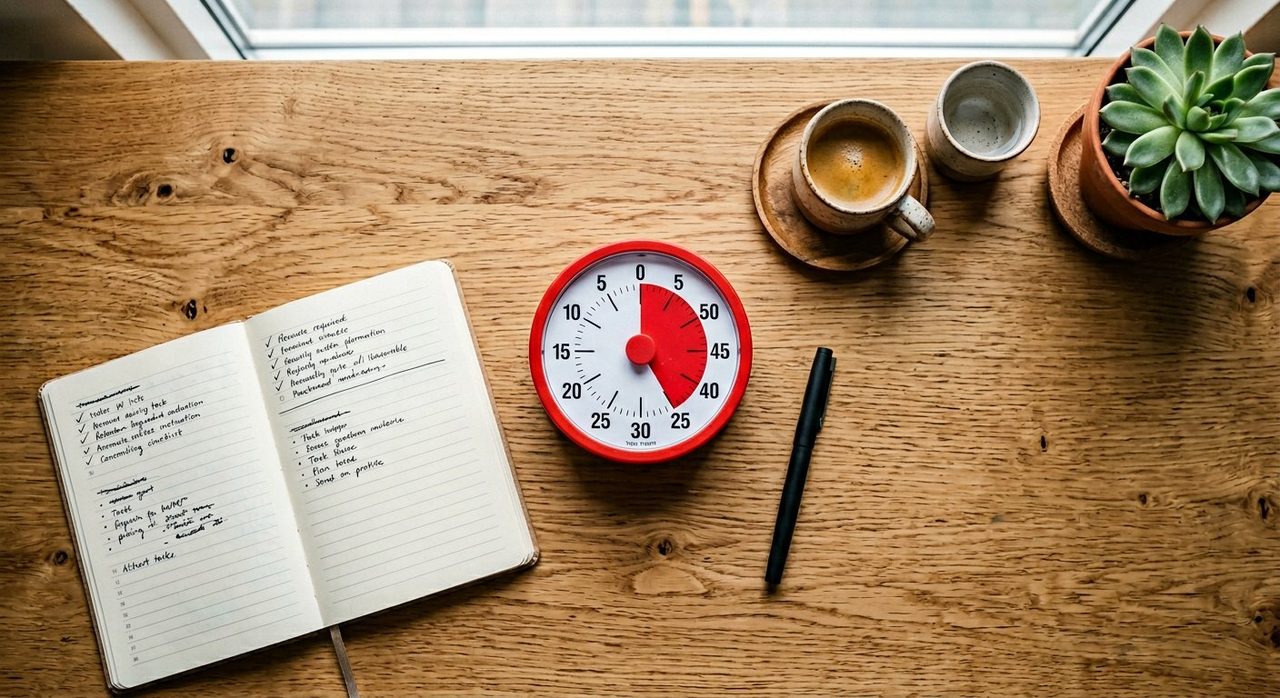
3. Two minutes of planning (analog, not digital)
Open a paper notebook (not your laptop). Write down:
- The one thing that, if you do nothing else today, would make it a successful day.
- Two or three secondary tasks.
- Anything you're worried about or distracted by (this gets it out of your head).
This takes literally two minutes and is the single biggest leverage point in the entire routine. You enter the workday with a plan instead of a panic.
4. Shower and get dressed (yes, really)
Working in pajamas feels efficient. It's not. The act of getting dressed for work — even casually — is a strong cue to your brain that it's time to focus. You don't need a suit; just not what you slept in.
5. Start work with the One Thing
The first 60–90 minutes of your workday is your highest-cognitive window. Spend it on the One Thing from step 3 — before opening email, Slack, or any feed. This is where deep work happens. See our full guide to deep work for remote workers.
What to AVOID in your morning
- Phone in bed. Reading email or scrolling before you've even moved primes you for reactive mode. Charge your phone in a different room.
- News before noon. News rarely changes between 7am and noon, but it absolutely changes your mood for the worse. Catch up later.
- Heavy meetings before 10am. If you control your calendar, reserve early mornings for solo work.
- "Just a quick check" of Slack. There is no quick check. It always becomes an hour.
The tools that help (none required)
Field Notes Pocket Notebook
For the 2-minute analog planning. The friction of writing by hand forces actual decisions instead of vague intentions.
Hatch Restore 2 Sunrise Alarm
Wakes you gradually with simulated sunrise instead of jarring alarm. Helps in winter months when natural light is hard to come by.
Insulated Water Bottle (32 oz)
Fill it the night before and put it next to your bed. Removes the "I'll drink water later" excuse.
A sample 45-minute morning
| Time | What |
|---|---|
| 7:30 | Wake. Water. Bathroom. NO phone. |
| 7:40 | 10-minute walk outside. |
| 7:55 | Shower, get dressed. |
| 8:10 | Coffee + 2-minute planning in notebook. |
| 8:15 | Start work on the One Thing. |
Final word
You don't need to wake at 5am or meditate for an hour to be a productive remote worker. You need to reconstruct, intentionally, the boundary between sleep and work that the office used to give you for free. Forty-five minutes, five simple steps, no app subscriptions required. Start tomorrow.
Frequently asked questions
Do I really need a morning routine if I work from home?
Yes — more than office workers do. Without a commute, the line between 'home life' and 'work mode' disappears. A short morning routine reconstructs that boundary intentionally, which dramatically improves focus during work hours.
How long should a remote-work morning routine take?
30–60 minutes is the sweet spot. Less than 30 and you don't get the boundary-setting benefit; more than 60 and most people stop doing it within a week.
Should I check email first thing?
No. Checking email first puts you into reactive mode all day. Wait at least 60–90 minutes — long enough to do one meaningful thing on your own agenda first.
Is exercise really necessary in a morning routine?
Movement is, but it doesn't have to be 'exercise.' A 10-minute walk outside has nearly all the morning benefits — sunlight exposure resets your circadian rhythm, motion warms up your body, fresh air clears the head.
What if I'm not a morning person?
The routine doesn't have to be at 6am. The principle — do something intentional for yourself before the workday — works at any start time. Just don't roll out of bed straight into Slack.
Spotted a mistake or want to suggest a product we should test? Get in touch — we read every message.