

Disclosure: WorkWise is reader-supported. When you buy through links on our site, we may earn an affiliate commission at no extra cost to you. Learn more.
At-a-glance recommendations
A fast comparison list for the products covered in this guide.
Sony WH-1000XM5 Noise-Cancelling Headphones
Best-in-class ANC. The "putting them on" ritual genuinely helps trigger focus.
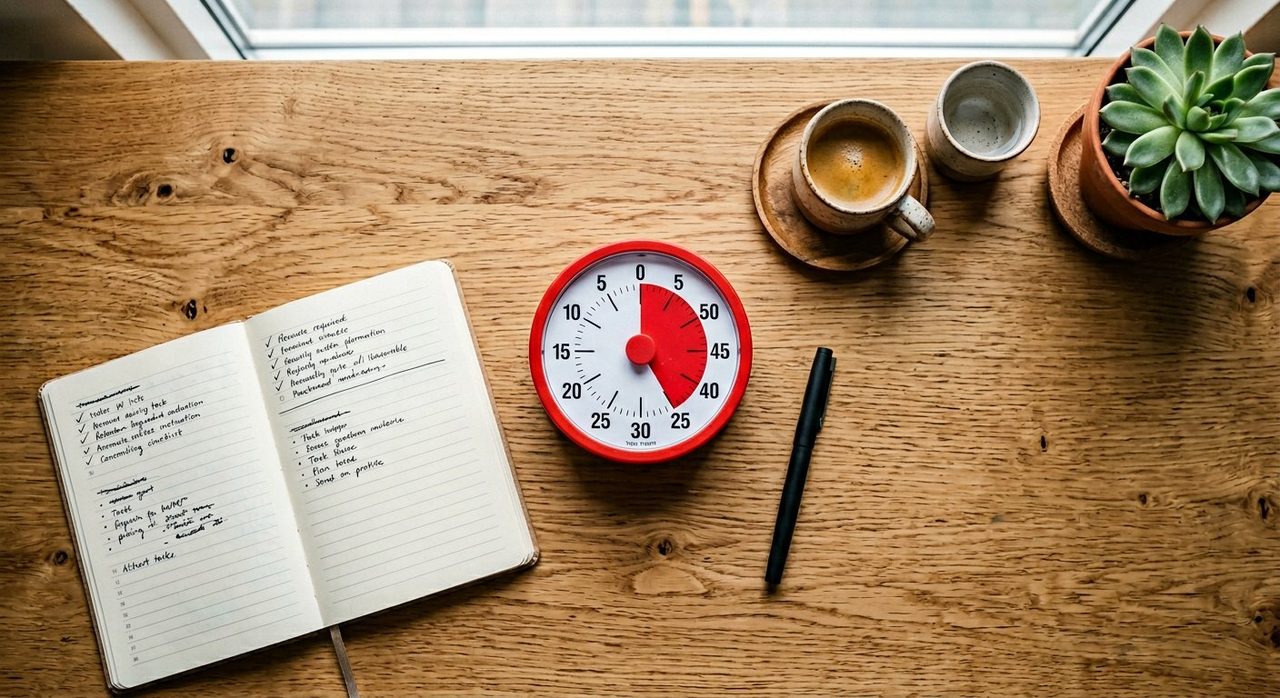
Time Timer Plus 60-Minute
No screen. No notifications. Just a red disk that visibly shrinks. The most underrated focus tool we own.
Most of us don't have a time problem. We have an attention problem. Eight hours of "work" splintered into 90 different micro-tasks produces less than two hours of focused effort would. This article is about how to actually get to that focused state — without joining a monastery or buying a $200 productivity planner.
What "deep work" actually means
Cal Newport popularised the term in his 2016 book, but the concept is older: cognitively demanding work performed in a state of distraction-free concentration that pushes your abilities to their limit. Three things define it:
- It's hard.
- It's uninterrupted.
- It creates new value (not maintenance of existing value).
Replying to email is not deep work. Writing the strategy doc is. Attending a status meeting is not deep work. Designing the system architecture is.
Why it's harder than it used to be
Two reasons, both structural:
- Our jobs have been re-engineered around interruption. Slack, Teams, email and meetings are designed to be responded to in minutes, not hours. Most workplaces implicitly penalise people who are "unresponsive" — i.e., focused.
- Our brains have been re-engineered too. The dopamine loop of refreshing notifications has trained us to feel restless after 12 minutes of single-task focus. The good news: this is reversible.
The 5-step deep-work practice
Step 1: Schedule it. Don't hope for it.
Deep work that "happens when I have time" never happens. Block two 90-minute deep-work sessions on your calendar tomorrow morning. Treat them like external meetings. Decline anything that lands in them.
Step 2: Define the deep-work task the night before
The number one killer of a deep-work session is starting it without knowing exactly what you're going to do. By 10:15 you're "researching" on Wikipedia. Avoid this:
- Last task of the workday: write down what tomorrow's two deep-work blocks will produce.
- Be specific. Not "work on report" but "draft sections 3 and 4 of the Q3 report."
- Lay out your tools (file open, references gathered) before you leave.
Step 3: Make distraction physically harder
This is the step I resisted longest. "I have willpower," I thought. I did not. The phone in another room (not face-down on the desk — another room) was the single most impactful change. The first three days I reached for it more times than I could count. By day ten the urge had genuinely faded.
Willpower is a finite, exhaustible resource. Don't rely on it. Instead, raise the cost of every distraction:
- Phone in a drawer in a different room. Not on the desk face-down — different room.
- Slack and email quit (not just minimised). Quitting them adds 8 seconds to reopening, which is enough.
- Browser tabs closed. Use a one-tab extension or just Cmd-Shift-W.
- Notifications off at the OS level — Do Not Disturb mode, scheduled.
- Wear noise-cancelling headphones, even in silence. They become a visual cue to family/roommates and a mental cue to you.
Sony WH-1000XM5 Noise-Cancelling Headphones
Best-in-class ANC. The "putting them on" ritual genuinely helps trigger focus.
Step 4: Use the right time structure
The classic Pomodoro 25/5 is too short for deep work. For genuinely demanding tasks, use:
- 90/15 — 90 minutes focused, 15 minutes off. This matches the natural ultradian rhythm of the brain (about a 90-minute attention cycle).
- 52/17 — slightly shorter; from a DeskTime study of high performers.
- The 4-hour ceiling — virtually no one does more than ~4 hours of true deep work per day. Don't try.
Step 5: Defend the recovery
The break is not optional. It's the part that lets the next focus block happen. During breaks:
- Stand up, look at something more than 20 feet away (your eyes need this).
- Walk, stretch, get water.
- Do not open a feed, news site, or email. These are not breaks; they're context-switches.
Environment matters more than willpower
The single highest-leverage thing you can do is make your work environment friendly to deep work:
- Same place, same time trains your brain to focus on cue. Stop working from the couch.
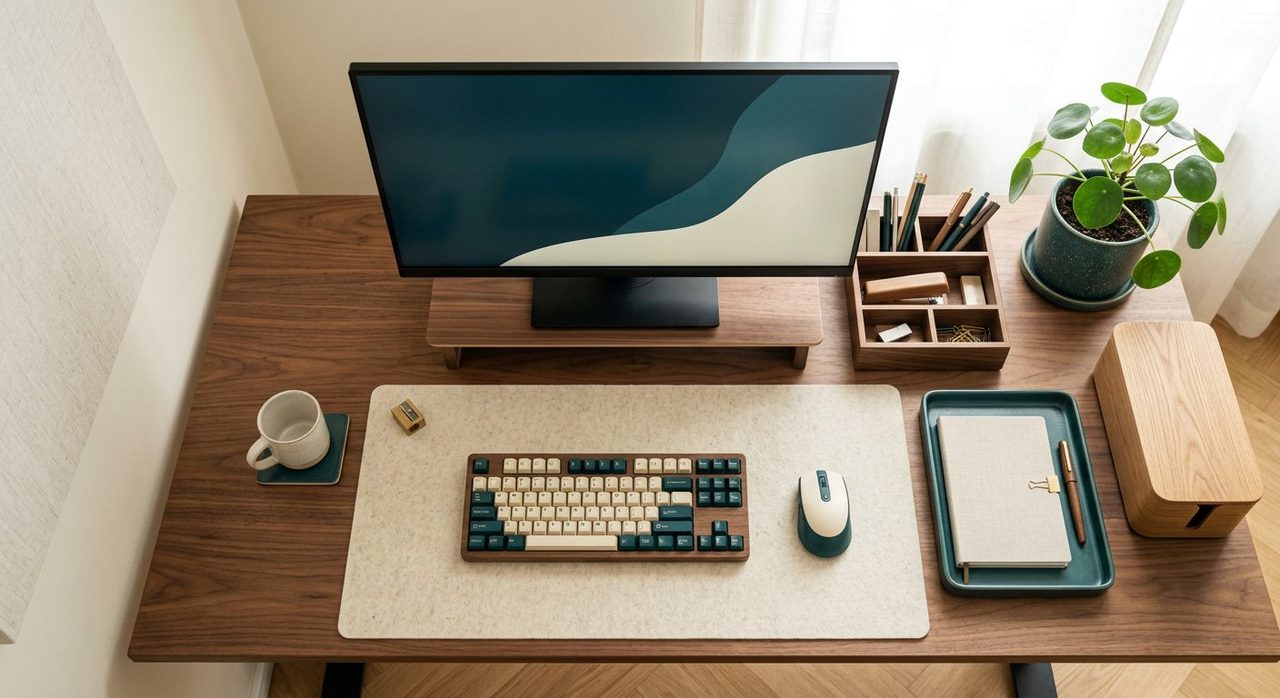
- Tidy desk. Visual clutter pulls attention. A 60-second tidy at the end of each day pays off the next morning.
- One screen. Multiple monitors are great for shallow work; for true deep work, one screen with one window is better.
- Right lighting. Cool, bright light in the morning; warmer in the evening. See our lighting guide.
The handful of apps worth using
- Freedom — schedule a block of sites and apps you can't access during focus blocks. The fact that even you can't override it (with the "Locked Mode" option) is the killer feature.
- Cold Turkey Blocker — more aggressive than Freedom; for the truly weak-willed (read: most of us).
- Notion / Obsidian — somewhere to capture the "shower thoughts" that interrupt deep work. Write them down, return to the task.
- Time Timer — physical 60-minute visual timer. Outperforms every app for the simple act of "set it and ignore it."
Time Timer Plus 60-Minute
No screen. No notifications. Just a red disk that visibly shrinks. The most underrated focus tool we own.
Common objections (and answers)
"My job has too many meetings for deep work." Probably true. The solution is structural: batch meetings into 2–3 days and protect the other days. Get your manager bought in by showing what you produced in a deep-work week vs a normal week.
"I'm a people manager — I have to be reachable." Even managers can carve out 60–90 minutes a day. Use early morning or late afternoon when others are in their own focus blocks. Set status to "Heads down — back at 11:00".
"I work in a noisy household." Noise-cancelling headphones, brown noise (not white — brown is gentler), and a clear "do not disturb" signal to housemates. A simple lamp or sign that means "in a focus block" works wonders over time.
A starter week-long protocol
- Sunday evening: pick one deep-work task per day for Mon-Fri.
- Each weekday morning: 90 minutes of deep work before opening email or Slack.
- Phone in another room during those 90 minutes, every day.
- Friday afternoon: write down what you actually produced. Compare to a normal week.
Most people who do this for one week immediately do it for a second.
Final word
Deep work isn't a productivity hack — it's a way of working that's becoming rare, which is precisely why it's increasingly valuable. The people who can still concentrate for 90 minutes on a hard problem will, over the next decade, eat the lunch of everyone who can't. Most of the work is environmental: schedule it, lay out tomorrow's task today, put the phone in another room, and let the focus follow. The hardest part is the first week.
Frequently asked questions
How long can the average person actually do deep work?
Research suggests 3–4 hours per day is the realistic ceiling, even for elite performers. Two 90-minute blocks (morning and afternoon) is a typical sustainable structure.
Does the Pomodoro Technique work for deep work?
The classic 25/5 is too short. A modified 50/10 or 90/15 cycle works much better for cognitively demanding tasks. See our Pomodoro guide for the full template.
How do I do deep work in a noisy household?
Three layers: noise-cancelling headphones for sound, a visual cue (closed door, sign, specific lamp) to signal 'do not interrupt,' and explicit family/roommate agreement on protected hours. All three together work; any one alone usually fails.
Can I do deep work if my job has a lot of meetings?
Yes, but it requires structural changes. Batch meetings into 2–3 days per week and protect the other days. Use early morning or late afternoon when most colleagues are in their own focus blocks.
Spotted a mistake or want to suggest a product we should test? Get in touch — we read every message.